Organising team building for 20 people is relatively straightforward. But what about 80, 150, or 300 colleagues? The challenges shift dramatically — and activities that work brilliantly for small groups can become complete disasters at scale. In Vienna, you have the added bonus of one of Europe's most walkable and photogenic city centres. In this guide we'll break down exactly which formats scale, which ones fail, and why Treasure Hunt Vienna is the go-to solution for corporate groups of all sizes.
The challenges of large-group team building
The larger the group, the more complex the logistics — and the greater the risk that half your attendees end up passively watching rather than actively participating. Large groups bring four specific challenges that any activity needs to address:
- Passive participation — in a group that's too big, people get lost in the crowd and stop engaging. At 100 people in one room, most participants become spectators.
- Logistical complexity — transfers, catering, materials, coordination, and timing all grow exponentially with group size. A smooth experience for 20 people becomes a logistical puzzle for 200.
- Waiting time — any activity with queues or rotations drains the group's energy fast. One hour of enthusiasm can evaporate into boredom if people spend 30 minutes waiting for their turn.
- Heterogeneity — a large company brings together people of different ages, fitness levels, departments, and seniority. The activity needs to work equally well for a 25-year-old analyst and a 55-year-old director.
The solution to all four challenges is the same: split the group into small, self-managing units that operate in parallel and come together only for a shared finale.
What works for 50+ people
For large groups, only formats that break into parallel mini-teams with a shared closing ceremony truly deliver — any activity that keeps everyone together the whole time fails above roughly 30 people. The formats that consistently deliver at scale:
- Scavenger Hunt / Treasure Hunt — mini-teams of 4–6 play simultaneously on the same route; everyone competes, scores are aggregated centrally, and the ceremony brings the whole company together
- Charity team building — groups work in parallel on separate projects (assembling equipment, garden work, building bikes for schools) and present results to the whole company at a shared ceremony
- Rally or orienteering race — a highly scalable format with checkpoint stations; teams move at their own pace and only converge at the finish
- Creative workshops in sub-groups — each team creates something different (a short film, a product pitch, an artwork) and results are presented to the assembled company
What all of these have in common: every participant is active simultaneously. No one is sitting idle waiting for their group's turn.
What doesn't work for large groups
Activities with a capacity ceiling of around 30 people are a logistical nightmare at scale — they create queues, unequal experiences, and a gradual loss of energy that's very hard to recover from. Formats to avoid for large groups:
- Escape rooms — standard capacity is 6–10 people per room; managing 100 people through them means 10+ staggered start times, some teams waiting two hours to play while others have already finished and are standing around
- Cooking classes — professional kitchens typically hold 20–30 people; splitting 150 attendees across multiple venues destroys the shared-experience feel
- Paintball / laser tag — equipment and arenas have hard capacity limits; large groups end up rotating in and out for hours while spectators lose interest
- Whole-group lectures, panels, or seminars — 150 people in one room listening for an hour delivers essentially zero team-building effect; it's a conference session, not a team activity
- Single-table dining games — formats designed for one table of 8–10 people simply don't translate to a room of 200
Why Vienna suits large corporate groups
Vienna's historic Innere Stadt (1st district) is uniquely well-suited to large-group outdoor team building. Within a roughly 1 km radius of Stephansplatz you have the Hofburg Palace, the Kunsthistorisches Museum, the Ringstraße, the Naschmarkt approach, and dozens of hidden imperial courtyards — all interconnected by broad pedestrian streets and narrow cobblestone lanes. For a parallel mini-team format, this density is a significant logistical advantage: multiple teams can operate simultaneously without ever crossing paths or competing for the same checkpoint space.
Vienna's infrastructure also makes large events easier to run than in many other European capitals:
- No traffic risk — the historic core is largely pedestrianised; teams walk freely without worrying about roads or trams
- Natural briefing spaces — the Burggarten, Volksgarten, Stadtpark, and Prater provide generous outdoor areas for assembling 200+ people without venue hire
- Excellent closing-ceremony venues — Viennese Heuriger wine taverns, palace courtyards, and riverside Prater restaurants all handle large groups comfortably and add to the occasion
- Easy transport — the U-Bahn gets everyone to the starting point efficiently; participants arriving by train or plane can reach the Innere Stadt within 15–20 minutes
For more on Vienna's best locations for team activities, read our guide to the best team building locations in Vienna.
Why Treasure Hunt Vienna scales to 300 people
Treasure Hunt Vienna scales without a capacity ceiling because every mini-team plays its own independent game — adding more teams puts no strain on the route, the experience, or the energy of the event.
The mechanic that makes it work
The core structure is identical for 10 participants and for 300: the group is divided into mini-teams of 4–6 people, each team receives the same briefing pack and sets off at a staggered start. Teams navigate Vienna's landmarks independently, solving puzzles and completing challenges at checkpoints along the Innere Stadt route. They cross paths on the streets but don't interact directly — each team tracks its own time and points. This means the experience for a team of five is exactly as intense and engaging whether there are 2 other teams or 50 other teams playing simultaneously.
Game Master deployment for large events
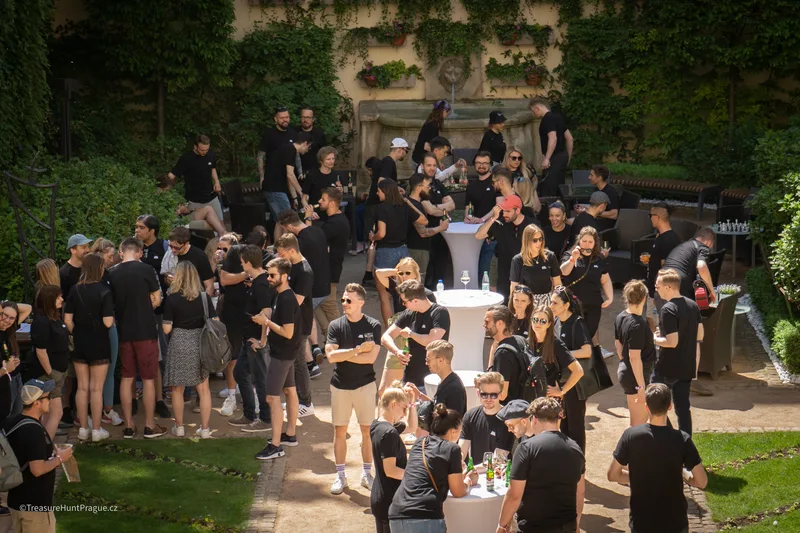
For events over 50 participants, Treasure Hunt Vienna deploys multiple Game Masters — typically one per 50–70 participants. Coordination is wireless; Game Masters are stationed at key checkpoints and reachable by radio throughout the event. This allows us to manage timing, assist any team that gets stuck, and ensure a smooth flow without bottlenecks. The closing ceremony — where all teams gather, scores are revealed, and the winning team is celebrated — is run by the lead Game Master and typically lasts 20–30 minutes.
We have successfully run events for 300+ participants from a single organisation. See our corporate event planning guide for more on combining the Treasure Hunt with a full-day programme including dinner or an evening reception.
Pricing for large groups
Treasure Hunt Vienna uses a simple flat-rate structure that makes large-group budgeting predictable: €590 for groups up to 25 people, then €22 per person for groups of 26 and above. For 100 participants, the total is €2,200; for 200 participants, €4,400. All Game Masters, materials, route coordination, and the closing ceremony are included — there are no hidden extras.
Large event logistics: checklist
The success of a large event is 50% activity and 50% logistics — work through this checklist before you contact any provider.
- Book at least 4–6 weeks in advance for groups over 50; 6–8 weeks for groups over 150
- Confirm a briefing area — an outdoor square or park works well for large groups and is free; indoor alternatives exist for bad weather
- Plan the closing ceremony venue — book a Heuriger, restaurant, or event space that can seat your whole group; ask your provider for recommendations
- Brief participants on dress code (casual, comfortable shoes) and what to bring (nothing — we provide everything)
- Prepare a weather contingency — Vienna's outdoor format is weather-dependent; discuss the rain plan with your provider when booking
- Arrange accessible options — confirm with your provider whether the route is suitable for participants with limited mobility and what adaptations are available
- Communicate start time clearly — for large groups, a 10-minute late arrival creates significant knock-on delays; send participants the meeting point and start time at least 48 hours in advance
Need help planning a large event in Vienna? Send us an enquiry — we'll put together a full programme proposal including logistics, timing, and pricing tailored to your group size.